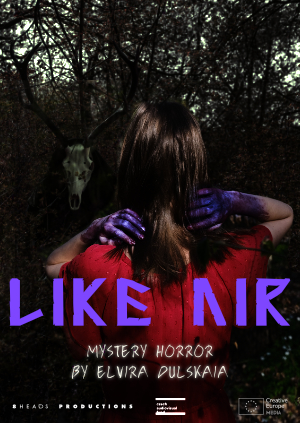
Like Air
Young woman on a journey into her forgotten past fights imaginary and real demons while exploring tentions between modern medicine and shamanic healing.
Director: Elvira Dulskaia
Jako vzduch
Synopsis
Misha, a surgeon in training, suffers hallucinations tied to her mother’s death and a forgotten past. Seeking answers, she travels to a remote village and meets Juraj, a healer with a mysterious gift. As her memories resurface, Misha discovers that Juraj is her half‑brother. They are bound by a dangerous legacy: their father’s failed ritual split the healing gift between them. Now the spirits demand reunion—even if it means one must die. In the final struggle, Misha must unite her medical skill with her spiritual power to save Juraj’s life.
Theme
Memory is the central theme of the film. The past is remembered differently by the two main characters, even though they exprienced the same childhood events. Over time, their memories shift, distort, and sometimes disappear—like air. The title of the film therefore refers not only to one of the character’s inability to feel pain but also to the fragile, vanishing nature of memory itself.
DIRECTOR‘S STATEMENT
My inspiration for Like Air comes from a small Siberian village where I grew up. In that place, rural shamanic traditions remain vivid and continue to coexist with the modern rhythms of everyday life.
Through this story, I want to explore the tension between modern medicine and traditional healing. This conflict is embodied in the relationship between Misha and Juraj — siblings that share fragments of the same supernatural gift, yet responding to the old tragic experience in profoundly different ways.
I aim to create a mystery‑horror film rooted in authentic family dynamics. The supernatural is undeniably present, but it also serves as a metaphor for the complexities of human relationships. Memory is a central theme. The past is remembered differently by Misha and Juraj, even though they lived through the same childhood events. Over time, those memories shift, distort, and sometimes disappear — like air. The title of the film therefore refers not only to Juraj’s inability to feel pain but also to the fragile, vanishing nature of memory itself.
Visually, the film draws inspiration from Northern shamanism, with its vivid colors and elemental symbolism. The style balances magical realism with folk horror, relying on emotional resonance rather than spectacle.
The ending suggests a reconciliation of the two worlds: Misha heals Juraj by combining medical knowledge with spiritual power. It points toward the possibility of family reunion and, ultimately, hope. Despite tragedy and mistakes, I want the film to close with the sense that a better future is still possible.
Participated at Script Circle Berlin 2025, European Genre Forum (Amsterdam-Zagreb-Tallinn) 2025





supported by Czech Film Fund, Creative Europe MEDIA, Plzeňský kraj